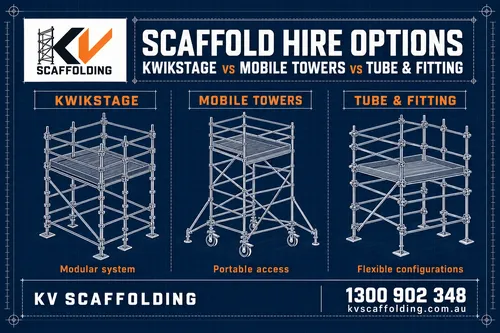

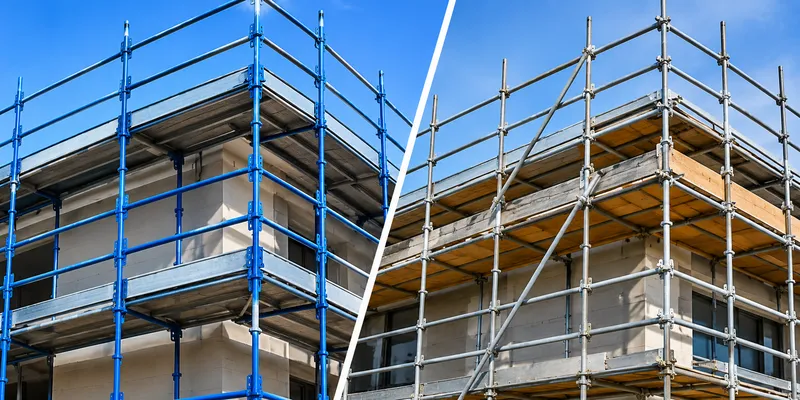
When planning scaffolding for a construction project, one of the decisions that may arise is which scaffolding system is most suitable for the building and the work being completed.
Two commonly discussed systems are Kwikstage scaffolding and tube and coupler scaffolding.
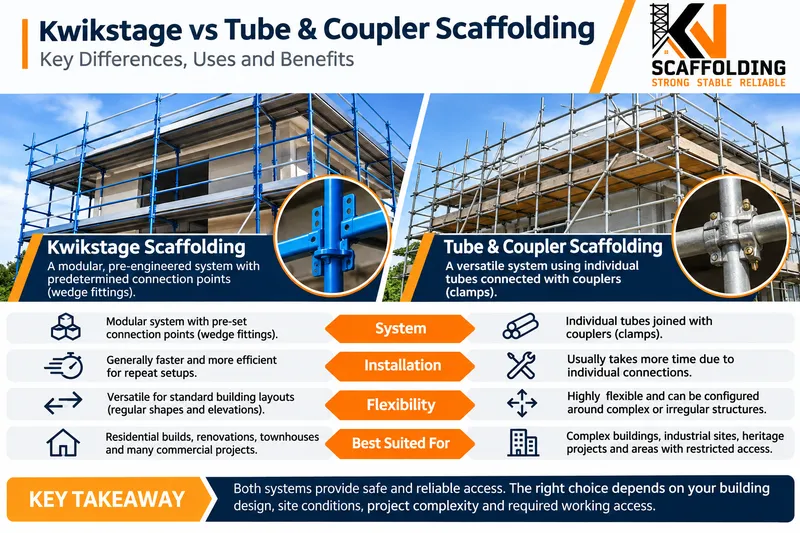
Both can provide safe working platforms and access at height when they are correctly designed, erected and maintained. However, the way the two systems are assembled is quite different, which makes each better suited to certain types of projects.
For many residential and straightforward commercial construction projects, a modular system such as Kwikstage provides an efficient and practical solution. Tube and coupler scaffolding, on the other hand, becomes particularly useful where the scaffold must adapt around unusual structures, complex geometry or restricted conditions.
So which one should you use?
Quick Answer: Kwikstage vs Tube Scaffolding
Kwikstage is generally better suited to projects with relatively regular building geometry where fast, repeatable scaffold bays and working platforms are required. Tube and coupler scaffolding provides greater freedom to create bespoke configurations around irregular structures and difficult access conditions.
Neither system is automatically better or safer. The right scaffold depends on the building, intended work, height, loads, access conditions and the configuration required.
WorkSafe Victoria describes tube and coupler scaffolds as metal tubes connected by couplers and notes that they can be assembled in a wide range of configurations, making the system highly versatile.
What Is Kwikstage Scaffolding?
Kwikstage is a modular prefabricated scaffolding system widely used for construction access.
Rather than connecting every tube individually with separate couplers, the system uses predetermined connection points on its vertical standards. Ledgers, transoms, braces and other components connect into these points using wedge-style fittings.
This creates repeatable scaffold bays that can be extended horizontally and vertically as the building progresses.
A typical Kwikstage structure includes standards, ledgers, transoms, braces, working platforms, guardrails, toe boards and appropriate scaffold access.
Because the basic geometry of the system is predetermined, scaffolders can often construct repetitive sections efficiently.
This makes Kwikstage particularly practical for work around houses, townhouses, renovations, extensions and many commercial building elevations.
KV Scaffolding provides Kwikstage scaffolding for residential and commercial construction projects throughout Melbourne and surrounding areas.
What Is Tube and Coupler Scaffolding?
Tube and coupler scaffolding takes a different approach.
Instead of relying on predefined connection points, individual scaffold tubes are connected using purpose-designed couplers.
The tubes can therefore be positioned in many different orientations and configurations.
This gives scaffold designers and scaffolders considerable flexibility when working around unusual structures.
WorkSafe Victoria describes tube and coupler scaffold as metal tubes connected by couplers to create the scaffold structure and support working platforms. Its ability to be assembled in a wide variety of configurations is one of the system’s key advantages.
Tube and coupler scaffolding can therefore be particularly useful where standard modular bay dimensions do not easily accommodate the structure.
Kwikstage vs Tube & Coupler Scaffolding Comparison
| Factor | Kwikstage Scaffolding | Tube & Coupler Scaffolding |
|---|---|---|
| System type | Modular/prefabricated | Individual tubes connected by couplers |
| Connections | Predetermined wedge connection points | Couplers positioned along scaffold tubes |
| Installation | Generally efficient for repetitive configurations | Usually requires more individual connections |
| Flexibility | Very good for conventional building layouts | Extremely flexible |
| Irregular structures | Can accommodate many layouts but remains modular | Particularly suitable for unusual geometry |
| Residential construction | Very commonly suitable | Usually used when project conditions require it |
| Commercial construction | Suitable for many projects | Useful for complex or specialised structures |
| Restricted areas | Depends on available bay configuration and site | Highly adaptable where custom positioning is required |
| Planning | Often more standardised | More bespoke planning may be required |
| Labour requirement | Can be efficient for repetitive elevations | May require additional erection time due to individual connections |
Need Kwikstage Scaffolding in Melbourne?
KV Scaffolding provides Kwikstage scaffolding hire and installation across Melbourne and surrounding areas for residential and commercial construction projects.
We work with builders, contractors, roofers, bricklayers, renderers, painters, renovators, developers and property owners who require reliable working access at height.
If you’re unsure what scaffold configuration your project requires, you don’t need to calculate it yourself.
Send us your:
- Building plans or elevations, if available
- Site address or suburb
- Photos of the building or work area
- Approximate building height
- Areas requiring access
- Type of work being completed
- Preferred installation date
- Expected hire period
Our team can review your project requirements and help determine an appropriate scaffolding solution.
Call KV Scaffolding on 1300 902 348 or request a scaffolding quote online.
Frequently Asked Questions
Kwikstage is a modular scaffold system using predetermined connection points and components. Tube and coupler scaffolding uses individual tubes joined by couplers, allowing a greater degree of customisation.
Not necessarily. Kwikstage is often more practical for regular building elevations and repetitive scaffold layouts. Tube and coupler is particularly useful where irregular geometry requires a highly customised scaffold.
Yes. Kwikstage is commonly suited to residential construction where working platforms are required around the external elevations of double-storey homes, renovations and extensions.
Generally, yes. Because tubes can be connected in many different positions rather than following predetermined modular connection points, tube and coupler can accommodate unusual structures and complex geometry.
On straightforward projects with repetitive layouts, modular systems such as Kwikstage can generally be erected efficiently because the connection locations and component sizes are predetermined. Actual installation time still depends on the size, height and complexity of the scaffold.
There is no universal answer. Price depends on the quantity and configuration of scaffold, height, site access, labour, transport, hire duration, engineering requirements and other project conditions.
Yes. Kwikstage can be used for many commercial construction, maintenance and refurbishment projects where its modular configuration suits the building and required access.
Plans, elevations and clear site photos are particularly useful. You should also provide the project location, approximate building height, areas requiring scaffold, type of construction work and anticipated installation and hire dates.