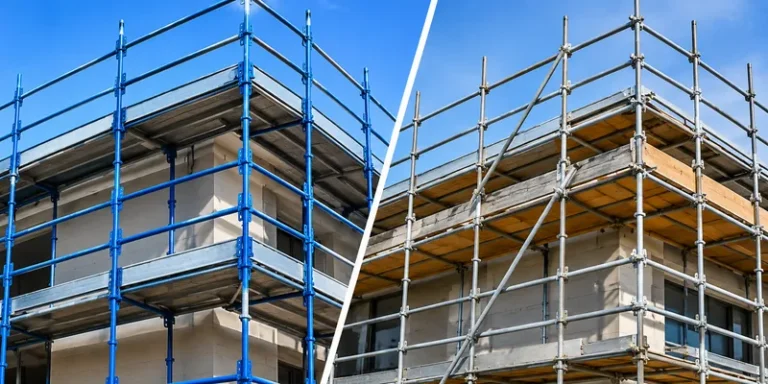

This article breaks down everything you need to make a confident decision: how the three main scaffold systems compare, what site factors drive the choice, what scaffolding hire actually costs in Melbourne right now, and what permits and safety obligations apply before a single tube goes up. By the end, you’ll know exactly what questions to ask any supplier before you commit. Whether you’re searching for scaffold hire near me or comparing scaffold rental options across Melbourne’s suburbs, the same principles apply.
What scaffold hire actually covers
Scaffold hire is not simply renting steel tubes from a yard. A complete hire package from a reputable supplier bundles the equipment itself, delivery to site, erection by qualified scaffolders, a written handover certificate, and dismantling at the end of the hire period. In terms of inspection arrangements, industry practice varies: some operators include periodic inspections at no extra charge, while others invoice them separately. It’s worth asking this question explicitly before signing anything, since the answer affects your total cost. Understanding what’s included before you compare quotes is the only way to avoid comparing apples with oranges.
The jobs that most commonly drive scaffolding hire requests include roof repairs and tile replacement, external painting and rendering, facade cladding, brickwork, window replacement at height, and guttering work. On the commercial side, retail fit-outs, warehouse ceiling maintenance, and short-duration facade refurbishments all generate regular demand. The project type directly influences which system is appropriate, which is why the comparison below matters.
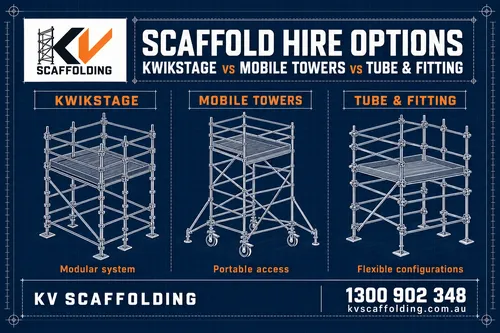
The three main scaffold systems side by side
Kwikstage: the modular workhorse for residential builds
Kwikstage is a prefabricated system where ledgers and transoms connect to standards via integrated wedge-ended connectors that lock into V-shaped pressings spaced roughly every 495 to 500 mm up the standard. There are no loose nuts and bolts to manage on site; the wedge is hammered home and the connection is made. This makes Kwikstage fast to erect for repetitive bay work across a full facade, and it’s compatible with accessories like stair towers, roof edge protection, and containment mesh.
It’s the system KV Scaffolding reaches for on most full-facade residential jobs and multi-storey builds, precisely because the consistent bay sizing and heavy-duty load ratings suit bricklayers, roofers, renderers, and painters all working the same structure. The key limitation to understand is that Kwikstage is not designed to be repositioned daily. It’s a fixed-position system best suited to longer-duration work where the scaffold stays put while multiple trades cycle through.
Mobile towers: fast, repositionable, and ideal for short tasks
Aluminium mobile scaffold towers are the go-to solution for painting, plastering, electrical work, and other tasks that shift position across a site. They assemble without specialist tools, roll on lockable castors, and are light enough for indoor use without damaging floor surfaces. For single-trade, short-duration work that moves from bay to bay, mobile scaffold hire is frequently the most cost-effective option available.
The trade-offs are real, though. Platform area is restricted, load capacity is lower than steel systems, and the tower requires a firm, level surface to be safe. Standard aluminium tower hire in Melbourne currently runs at approximately A$150 to A$350 per week for typical heights, with delivery and collection charged separately. That makes a one-week all-in budget of roughly A$400 to A$900 for a standard tower with metro Melbourne delivery, a reasonable starting point for budgeting purposes.
Tube-and-fitting: flexible for complex or irregular structures
Tube-and-coupler scaffolding is the most adaptable option available. Individual tubes are joined with right-angle and swivel couplers at almost any point along their length, meaning the system can follow curved walls, split-level sites, heritage building irregularities, and any configuration that a modular bay system simply can’t accommodate. Where the structure won’t conform to a standard grid, tube-and-fitting is often the only practical answer.
The trade-off is time and labour. Every coupler must be positioned and tightened individually, which makes erection and dismantling slower and the labour component of your quote higher. For straightforward residential jobs with regular facades, tube-and-fitting is rarely the most cost-effective path. It earns its place on complex plant installations, heritage facades, and any site where irregular geometry rules out a modular approach.
How to assess your site needs before booking
Height, working load and hire duration
Three variables determine your system before anything else. Working height is the first: a potential fall of more than 4 m triggers High Risk Work Licence obligations for the erecting crew, and heights above 2 m already require a Safe Work Method Statement before work begins. Platform load is the second variable, determining whether a lightweight aluminium tower is sufficient or whether a heavy-duty steel system is required for your materials and trade. Duration is the third: weekly rates and mobilisation costs mean a two-day painting job and a twelve-week renovation can point to entirely different systems when you work through the full cost.
Site access and ground conditions
Your supplier needs specific site information before quoting accurately. Access width for a delivery vehicle, ground type (concrete slab, compacted gravel, soft fill, or sloped site), proximity to overhead powerlines, and whether a public footpath or road verge will be affected all shape the quote. Soft or uneven ground may require engineering input on soleboards and base plates, which adds cost. Inner-suburb terrace renovations in Melbourne often involve extremely tight side access, while sloped block builds in the outer suburbs present their own foundation challenges. Flagging these details upfront prevents surprises on delivery day.
What scaffold hire costs in Melbourne in 2026
Weekly hire rates by system type
Based on current 2026 Melbourne market rates, aluminium mobile towers typically hire for A$150 to A$350 per week depending on platform height. Kwikstage and steel frame systems run from A$300 to A$800 per week for typical residential quantities, with larger or multi-level installations exceeding that range. Melbourne and other capital cities generally run 10 to 20 per cent above national averages, so rates quoted for regional projects won’t translate directly to your inner-suburb renovation.
The additional charges that blow out budgets
Delivery and return transport for a Kwikstage residential job typically adds A$150 to A$900 depending on load size, distance, and access. Erection and dismantling labour is frequently comparable to or greater than the hire rate itself: based on current Victorian market benchmarks, erection and dismantling on a single-storey perimeter scaffold typically runs approximately A$1,900 to A$3,800. For a standard Melbourne double-storey house using Kwikstage, a realistic total project budget sits between A$2,000 and A$8,000 or more, factoring in hire duration, transport, labour, and any permit fees.
The weekly hire charge is only one part of your total cost, which is why a complete installed quote, itemising hire, delivery, erection, dismantling, and any permit administration, is the only figure worth comparing between suppliers. Any quote that bundles everything into a single line is one you can’t properly evaluate.
The extras that most often catch homeowners off guard include permit fees when public land is affected, traffic management plans where the footpath or lane is occupied, and inspection costs if the hire period extends beyond 30 days. Under Australian safety standards, scaffolds must be inspected by a competent person at intervals not exceeding 30 days while in service; depending on the supplier’s pricing structure, this may be included in your package or invoiced separately. Ask the question explicitly before signing.
Permits and safety requirements you can’t skip in Melbourne
When a council permit is required for scaffold installation
A scaffold installed entirely within private property generally doesn’t require a separate council permit in Melbourne. The moment the scaffold oversails, occupies, or blocks a footpath, nature strip, or road reserve, however, a permit to occupy public land is required before any equipment goes up. Requirements differ between municipalities: the City of Melbourne processes a consent for works covering public space occupation; Yarra City Council issues a road and footpath occupation permit; Stonnington requires a road occupation permit; and Port Phillip issues a street occupation permit and expressly states that work must not start before approval is granted.
Most councils also require a traffic or pedestrian management plan where the footpath or traffic lane is affected, along with public liability insurance (Port Phillip specifies a minimum of A$20 million cover). Permit lead times across Melbourne municipalities typically add one to four weeks to the programme, so confirming your requirements with the relevant council before you finalise your construction timeline is essential, not optional.
Australian safety standards and licensing obligations
The AS/NZS 1576 series governs scaffold design, components, and use across Australia. The core parts covering general requirements, couplers, prefabricated and tube-and-coupler systems, and suspended scaffolding apply to virtually every hire situation. In Victoria, the WorkSafe Scaffolding industry standard sits alongside these, specifically addressing training, design, erection, alteration, dismantling, inspection, and maintenance.
The critical licensing threshold is this: erection, alteration, or dismantling of scaffolding where a fall of more than 4 m is possible requires scaffolders to hold the relevant High Risk Work Licence (Basic, Intermediate, or Advanced, depending on the scaffold type). Any scaffold where a person could fall more than 2 m constitutes high-risk construction work and requires a Safe Work Method Statement before work begins. Scaffolds must be inspected by a competent person before first use and at intervals not exceeding 30 days while in service. Hiring from a licensed, insured operator that provides written handover certificates and scheduled inspections is the simplest way for homeowners and builders to manage their duty of care on site.
How KV Scaffolding handles Melbourne scaffold hire
A Melbourne renovation case study
To illustrate how these factors come together in practice, consider a typical inner-suburb project. A double-storey brick home in Melbourne’s inner suburbs required full-facade Kwikstage scaffold, roof edge protection, and stair tower access for a roofing and rendering crew working simultaneously. The scaffolding contractor conducted a site inspection, managed the council permit application for footpath occupation, and completed erection with a qualified crew in a single day. A written handover certificate was issued before either trade accessed the platform, a 30-day inspection was completed on schedule, and dismantling followed within two days of the final trade signing off. This is the kind of end-to-end coordination that saves builders and homeowners significant time and avoids costly permit oversights.
KV Scaffolding’s services and safety credentials
KV Scaffolding provides the full range of scaffolding hire services across Melbourne’s residential and small commercial sector:
- Kwikstage scaffolding for residential and small commercial builds
- Roof edge protection systems
- Stretcher scaffold stairs for equipment and material access
- Two plank walkways for safe site access paths
- Stair void protection barriers
- Scaffold containment mesh for debris control
KV Scaffolding’s installations are carried out by certified professionals, with equipment inspected before handover. The team operates across Melbourne and surrounding suburbs and works with clients to navigate permit requirements across Melbourne’s major municipalities. When assessing any scaffold hire provider, ask them to provide evidence of current licences, insurance coverage, and their inspection and handover process, these are the details that separate compliant operators from those cutting corners.
Your simple scaffold hire checklist
Before committing to any scaffold hire provider, run through these points:
- Confirm you have a written quote that itemises hire, delivery, erection, and dismantling separately.
- Verify that all components comply with the relevant AS/NZS 1576 parts.
- Ask for confirmation of the erecting crew’s High Risk Work Licence class.
- Check that the supplier carries current public liability insurance.
- Require a written handover certificate at installation, a scheduled 30-day inspection, and a clear process for reporting damage or requesting alterations during the hire period.
This is the checklist KV Scaffolding works through with every client before a job starts. If you’re comparing suppliers and want a no-obligation site inspection, get in touch with the KV Scaffolding team directly. It’s the fastest way to get an accurate quote and confirm which system fits your project.
The bottom line on choosing and booking scaffold hire
Kwikstage is the right call for fixed, heavy-duty residential and commercial facade work where multiple trades need access over an extended period. Mobile towers suit light, repositionable tasks that move across a site. Tube-and-fitting earns its place on complex or irregular structures where modular systems can’t be made to fit. Cost alone is a misleading comparison point: the only figure worth comparing is a complete installed quote from a licensed operator, covering hire, transport, labour, and any permit fees.
Permit obligations and safety standards for Melbourne scaffold hire are non-negotiable. Falls above 2 m trigger SWMS requirements; falls above 4 m require licensed scaffolders; any scaffold affecting public land requires council approval before work begins. These aren’t administrative formalities, they exist because scaffolding failures carry serious consequences, and the duty of care sits with the person or company controlling the site.
KV Scaffolding manages scaffold hire and temporary scaffolding hire across Melbourne, handling everything from permit applications to 30-day inspections so clients can focus on the build. If you want the right system chosen correctly the first time and your scaffold hire booked with full compliance, reach out to the KV Scaffolding team for a site inspection and itemised quote.